Ceiling cracks and when to worry about them can be difficult to judge, especially since cracks caused by an old house settling can look almost identical to the ones that signal real trouble. This 10-point checklist for Brisbane homeowners will help you identify which type of crack you’re looking at.
Picture the moment: you’re standing in the hallway with a coffee in hand and you spot it, a hairline crack running across the ceiling that definitely wasn’t there last month, or a soft dip near the light fitting that gives slightly when you press it.
Most homeowners freeze right there, unsure whether it’s nothing or the start of something that needs a proper ceiling repair and replacement job before it gets worse. Run through the 10 checks below against what’s on your ceiling right now, and you’ll know before you pick up the phone.
Why ceilings crack and sag in the first place
Plasterboard moves. Timber frames expand and contract with Brisbane’s humidity swings, older homes settle on their stumps over decades, and new builds go through a shrinkage period while the timber dries out fully. None of that is unusual on its own. What matters is the pattern. A crack that shows up once and stays the same size is a different problem to one that’s still growing three weeks later.
At MLR Plastering & Interiors, the ceiling calls we get tend to fall into two almost opposite camps. In an older Queenslander, it’s often a hairline crack along a cornice or a ceiling joint that’s been there through a few wet seasons and never moved. In a home built in the last couple of years, it’s more often a straight crack running the length of a room where the frame is still settling into its final position. Both can look alarming under a bright light, and neither one, on its own, tells you much. The pattern over time is what matters, not the first sighting.
Ceiling cracks when to worry, 10 things to check
Work down this list against what’s actually happening on your ceiling. The first few are about the crack itself, the middle stretch is water, and the last few tell you when to stop using the room altogether.
- Hairline crack under a millimetre wide, running in a straight line. That’s usually the joint between two sheets letting go slightly, a scrim tape lift or a shrinkage crack, patched in an afternoon.
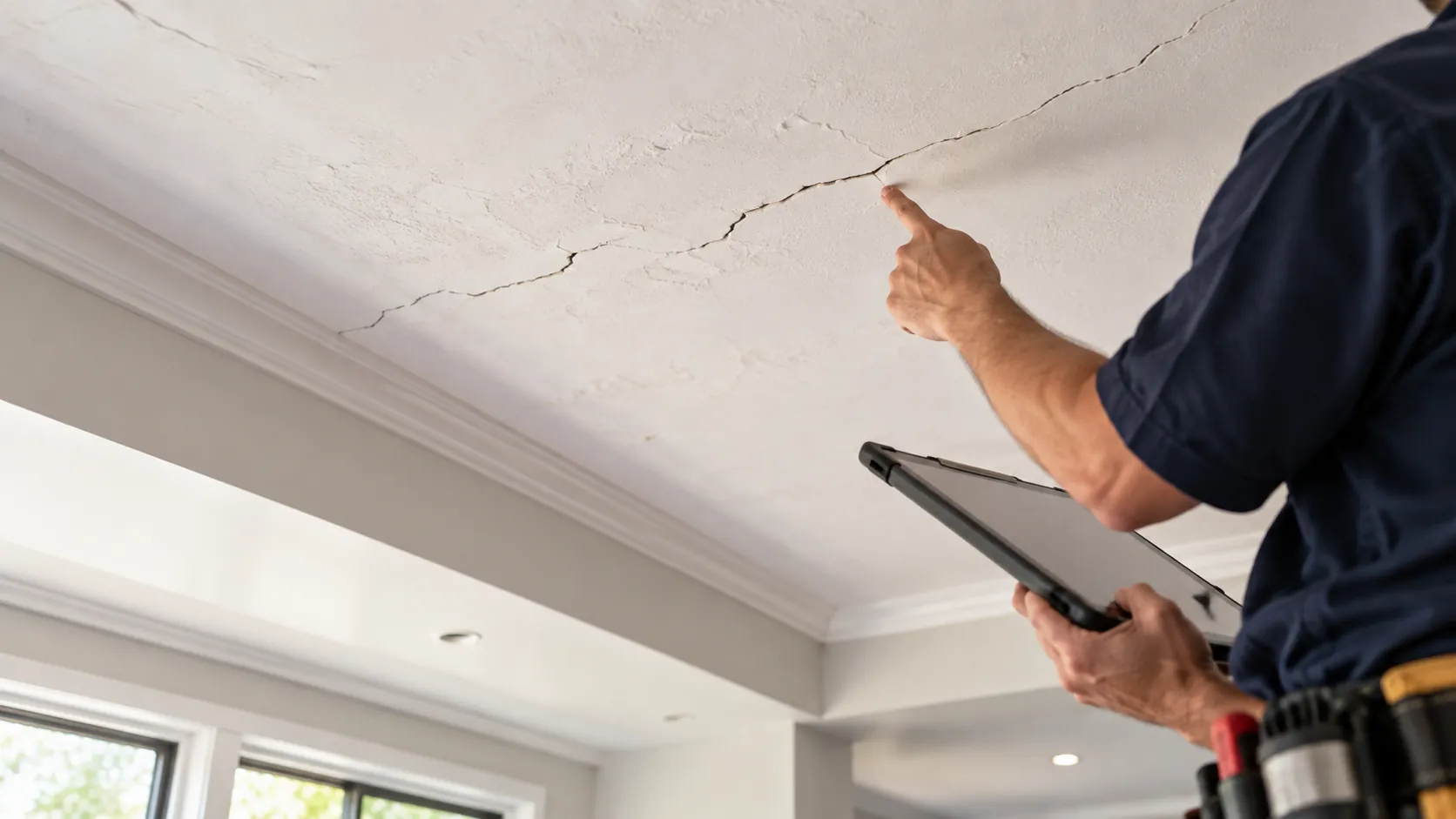
- Crack wider than a few millimetres, running diagonally across a corner, or stepping in a zigzag. Worth a proper look. Diagonal and stepped cracks usually point to movement in the structure behind the sheet, not just the plaster skin.
- Crack that keeps coming back after being patched, or one that’s clearly grown since you first noticed it. Something underneath is still moving.
- A soft or springy patch anywhere on the ceiling, with or without a visible crack. A patch fixes the surface. A soft patch means the sheet has lost its grip on the battens or soaked up moisture, and it needs to come down.
- A brown or yellow ring that’s spreading, even slowly. Water’s tracking through from somewhere above and it rarely announces itself with a dramatic leak.
- Bubbling or peeling paint around a stain. The paint film has lifted because moisture got underneath it before a mark ever showed.
- A musty smell in the room with no visible mark on the ceiling at all. That usually means dampness is building up in the roof cavity that hasn’t broken through yet.
- A bulge you can see from across the room, not just feel with your hand. That’s a genuine structural sag, not a surface issue.
- Water actively dripping or pooling on the surface, not just a stain. Get everyone out, put a bucket down, and don’t stand underneath it in the meantime.
- A crack that’s visibly widened in the space of a day or two, not weeks. That’s active movement, not ordinary settling, and it needs eyes on it now.
What water damage actually looks like on a ceiling
Items 5 to 7 are all water finding its way in before you ever see the source. Press gently on a stained patch. If it gives like a wet sponge instead of solid plaster, water’s already sitting behind the sheet, whatever the surface looks like from a metre away.
We’ve written a longer breakdown of what to do the moment you spot a water stain, including how to protect the room while you wait on a trade, over on our water damage ceiling guide.
The Queensland Government’s housing advice notes that mould thrives in exactly these conditions, damp and poorly ventilated spaces where moisture has nowhere to go, and it can affect respiratory health if it’s left to spread.
Is a sagging ceiling dangerous, and when to stop using the room
Yes. Items 8 to 10 are the ones that mean stop using the room, not book it in for next month. Plasterboard is heavy even when it’s dry, and once it’s absorbed water that weight climbs fast, a gyprock ceiling isn’t built to carry it hanging on for long. A ceiling can look fine from below right up until a saturated sheet lets go completely. If you can see a visible bulge, especially near a light fitting or where two sheets join, keep people out of that room until it’s been assessed.
The Queensland Building and Construction Commission’s Standards and Tolerances Guide draws the line between cosmetic issues and defects that affect a building’s structural performance, and genuine ceiling sagging can sit on the structural side of that line, not just the cosmetic one.
If any of items 8 to 10 apply, don’t paint over it and hope. Get someone out to look at it properly.
Cost is the other reason to move early rather than late. Catching a slow leak while it’s still a coin-sized stain usually means cutting out one sheet, patching, and matching the paint. Leave the same leak for another two wet seasons and you’re looking at a full sheet replacement, new cornice, and repainting the whole ceiling once the sagging spreads past the original spot. This checklist isn’t about being alarmist. It’s about knowing which of those two jobs you’re actually looking at.
Every ceiling tells a different story once you’re actually up in the roof cavity with a torch, which is why photos over the phone only get us so far.
MLR Plastering & Interiors has been sorting cracked and water damaged ceilings across Brisbane and South East Queensland for over 15 years, so we’ve usually seen your particular version of the problem before.
If any of those 10 checks match what you’re seeing, call 0452 216 493 or get in touch and we’ll come out, have a proper look, and give you a straight answer on whether it’s a patch, a partial replacement, or nothing to worry about at all.
Frequently asked questions
Is a sagging ceiling dangerous?
Yes. A ceiling that’s visibly bulging or feels springy under hand pressure has usually taken on weight it wasn’t designed to carry, most often from water sitting behind the sheet, and it can fail without much warning. Keep the room clear and don’t stand underneath it until it’s been assessed by someone who can get up in the roof cavity.
What do dangerous ceiling cracks look like?
Dangerous cracks run diagonally or in a stepped pattern rather than a straight line, keep growing over days rather than staying still, and often show up alongside sagging or a stain. A hairline crack that hasn’t changed in months is a different situation.
Are ceiling cracks normal in Brisbane homes?
Yes, to a point. Timber-framed homes move with the seasons and new plaster goes through a shrinkage period as the frame dries out, so a small hairline crack along a sheet joint is common in both older Queenslanders and newer builds, and rarely urgent on its own.
Should I patch a ceiling crack myself?
For a small hairline crack, a basic filler and touch-up paint will usually hold. Anything wider, growing, or paired with sagging or moisture needs a proper look first. Patching over a structural issue just hides it until it gets worse.